
 UltimateGoodNews
Barnabas Seeks Out Saul in Tarsus
01-05-2026 - Posted by Geert-JanOriginally posted on April 30, 2026 – by Andre Piet
summary of a lecture under the title:
Saul Sought Out
The Bible passage discussed is Acts 11:19-26
This passage about the events in Antioch does not stand by itself, but follows the turning point at which, through Peter, the door to the nations was opened. What subsequently takes place in Antioch connects directly with that development.
-Acts 10; 11:19-
The stoning of Stephen marks the official rejection of the Messiah by Israel. First the Messiah was crucified; now the message of the risen Messiah is also rejected. In doing so, the Sanhedrin confirms its earlier rejection.
-Acts 7:54-60; 8:1-
The oppression that follows the stoning of Stephen leads to the scattering of the believers. What arises out of necessity proves to be the means by which the word spreads precisely outside Judea, like seed being scattered.
-Acts 8:1; 11:19-
The scattered believers initially speak exclusively to Jews. This fits with the original expectation that Israel would first come to acknowledge the Messiah. Only after that would the nations come into view.
-Acts 3:19-21; 11:19-
In Antioch a breakthrough takes place because some also speak to Greeks. There is a manuscript difference here: some read “Greeks” (Gentiles), others “Hellenists” (Greek-speaking Jews), but the contrast in the context — first only to Jews, then also to others — indicates that actual non-Jews are meant here. In Antioch a decisive step is taken toward the nations.
-Acts 11:19-20-
Some from Cyprus and Cyrene, Jews from the diaspora and familiar with the Greek world, speak in Antioch also to Greeks. They evangelize the Lord Jesus. That means: the good message they tell is that God has roused Jesus and made Him Lord. It was not Jesus as He walked on earth before His death who was heralded, but the One who was roused and exalted by God.
-Acts 11:20-
Believing is not presented in Scripture as a process of choice, but as the affirming of what is heard. Whoever believes the evangel thereby turns back to the Lord; that is one and the same movement. The expression “coming to faith” adds a step that Scripture does not know. The text speaks simply of “believing”: the acceptance of what is proclaimed. Or better still: trusting in Who is proclaimed.
-Acts 11:21-
Barnabas is sent from Jerusalem to Antioch to take stock of the new development of the breakthrough to the Greeks. As soon as he arrives, he sees “the grace of God.” In what is happening, he recognizes not human success, but God’s work.
-Acts 11:22,23-
The words for grace (charis) and joy (chara) are directly related in Greek and come from the same root. Grace is that which makes glad: it is an undeserved favor that you receive without claim, and precisely for that reason it awakens joy and gratitude. That effect is characteristic of grace. When Barnabas sees the grace of God, he therefore sees not only what is happening, but he recognizes God’s work in the joy and the faith it produces.
-Acts 11:23-
Barnabas’ appeal is not to go forward, as though something still has to be added, but precisely to remain with what is there. For from a source you can continually draw, and a foundation is precisely intended as a fixed place.
-Acts 11:23-
Barnabas is described as a good man, full of holy spirit and faith. That explains his assessment: he sees and acknowledges what God is doing. The growth of the ecclesia is described passively: a multitude is added. It is the Lord who adds, not man who builds something. The word sounds, people believe, and the Lord adds.
-Acts 11:24-26; 2:47-
From this moment onward, Antioch becomes a new center in Acts. Where Jerusalem was the starting point, Antioch becomes the base of operations for the service to the nations. From here Paul would repeatedly undertake his journeys and also return again.
-Acts 11:20; 13:1-3-
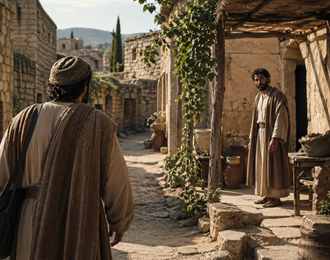
Barnabas, a Levite from Cyprus and known as “son of consolation,” had already in the earliest beginning parted with the land he possessed. Barnabas was also the one who took Saul under his wing when he was distrusted in Jerusalem. He therefore knew Saul personally and knew of his calling to the nations; that is why he now deliberately seeks him out in Tarsus in order to involve him in the work in Antioch.
-Acts 4:36-37; 9:27; 11:25-
Saul had been out of sight for years since his departure from Jerusalem and was staying in the regions of Syria and Cilicia. During that time he was not silent, but he did herald outside the view of the Acts account. Saul’s return in Antioch, on Barnabas’ initiative, brings him forward again and marks the beginning of his public service and stamps the continuation of the book of Acts.
-Acts 9:30; 11:25; Gal. 1:21-
Barnabas and Saul are together with the ecclesia for a whole year and teach a considerable throng. Nothing is set up or organized; no structures, no programs — the word is opened and taught, and in that lies all that is needed for upbuilding.
-Acts 11:26-
Barnabas and Saul are initially always mentioned in that order, with Barnabas having the leading role and taking Saul along with him. But when Saul acts against Elymas in Cyprus and is also called Paul there for the first time, the order shifts: from that moment on it is Paul and Barnabas; by this it becomes visible that the lead in the service passes over and Paul receives the principal role.
-Acts 11:26; 13:9-
Teaching is the core of coming together: the word is opened and explains itself. Authority lies in Scripture, not in the one who speaks.
-Acts 18:11; 28:31-
In a historical account such as Acts, believers are almost standardly called “learners” (disciples), because learning and receiving are what visibly characterize them. Yet in “the letters” they are never addressed as learners. For then the emphasis is not on what man does, but on the position God has given believers. Then they are called, for example, hallowed ones, called ones, or chosen ones.
-Acts 11:26; Rom. 1:7; 1 Cor. 1:2-
For the first time, learners in Antioch are called Christians. This name was not chosen by themselves, but was given by the outside world. The designation “Christian” occurs only three times in the New Testament and each time in a context from outside. There is no indication that believers called themselves this. The designation “Christians” (lit. Christianians) evidently carries an element of distance or mockery. Under the name of “Christian” one suffers.
-Acts 11:26; 26:28; 1 Pet. 4:16-
Delen:
Categories
Recent blog items
- Where Expectation Disappears
- Colossians 3:5 – Deaden, Then
- Colossians 3:4 – Appearing With Him In Glory
- Newsflash: Is a crisis looming over the Temple Mount?
- “Entirely Different in Freedom” [In vrijheid geheel anders] — Anastasia Zoë
- the rhythm of seven
- Newsflash: Netanyahu Wants U.S. Support Down to Zero
- a great affliction such as has not occurred