
 UltimateGoodNews
“Him” with a lowercase or uppercase H?
17-04-2026 - Posted by Geert-JanOriginally posted on January 21, 2010 – by Andre Piet
In the previous weblog I wrote about Romans 8:20,21, which says:
For to vanity was the creation subjected, NOT VOLUNTARILY, but because of HIM Who subjects it, in EXPECTATION, that the creation itself also shall be freed from the slavery of corruption…
I have been approached from various sides about this and asked whether “Him” is really correctly represented here with a capital letter. Since the Greek original text makes no distinction between lowercase and uppercase letters, “him” could also be read here. The idea then is that creation was subjected to vanity by Adam. Did Paul not write a few chapters earlier (5:12) that through one man sin, and thereby death, entered into the world? That last point is certainly true: through Adam death passed through to all mankind, “on which all sinned.” But does that make Adam the one who subjects creation to vanity (=meaninglessness)? No, for Adam himself was one subjected. Besides, in that case it still would have been caused by the choice of a creature and thus (as far as Adam is concerned) voluntarily. That conflicts with the text. But decisive is the rest of the clause. Literally it says:
… NOT VOLUNTARILY BUT BECAUSE OF HIM WHO SUBJECTS IT UPON EXPECTATION…
The subjection of creation to vanity has a basis. It takes place “upon expectation.” Who other than GOD provides this foundation of expectation? The meaninglessness to which this creation has been given over has a solid basis. The meaninglessness serves a purpose! GOD is the One acting in this and in the future He will reveal its meaning. The good news is not only that “the sufferings of the current era” are temporary and therefore passing. No, it is also necessary evil. A good GOD would give evil no place if it were not necessary in order to achieve His ultimate purpose. Even if we as small creatures sometimes grope completely in the dark—nothing happens for nothing. GOD makes no mistakes!
——————————————————-
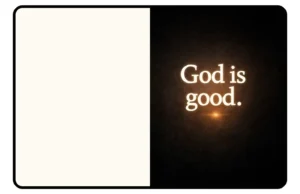
The left half of the above picture cannot reveal the text “God is good.” For that, as on the right half, a dark background is needed. Goodness and love too cannot be made manifest without contrast.
Delen:
Categories
Recent blog items
- Where Expectation Disappears
- Colossians 3:5 – Deaden, Then
- Colossians 3:4 – Appearing With Him In Glory
- Newsflash: Is a crisis looming over the Temple Mount?
- “Entirely Different in Freedom” [In vrijheid geheel anders] — Anastasia Zoë
- the rhythm of seven
- Newsflash: Netanyahu Wants U.S. Support Down to Zero
- a great affliction such as has not occurred