
 UltimateGoodNews
how long does “the day of indignation” last?
01-05-2026 - Posted by Geert-JanOriginally posted May 01, 2026 – by Andre Piet
For the great day of their indignation came, and who is able to stand?
–Revelation 6:17–
the appointed term of the great affliction
Scripture leaves no doubt that the great affliction for Israel is a measured period. It is indicated as “a season, seasons and half a season,” as 42 months and 1260 days. Each time it concerns a bounded period of time. Accurate to the year, the month, and even the day. (Dan.7:25; Rev.11:2,3; 12:6; 14; 13:5)
At the end of that affliction the Messiah appears. That moment is marked by signs in heaven: the sun is darkened, the moon is not giving its light, and the stars are falling from heaven. The Lord Himself places these events in Matthew 24: they follow “immediately after the affliction of those days.” Then the sign of the Son of Mankind appears. (Matt.24:29-31)
After the appearance of the Messiah, Israel is first gathered. The Lord dispatches His messengers to gather the chosen people together. This corresponds with Revelation 7, where we see a vast throng from all nations gathered (=Israel). They are coming out of the great affliction (Rev.7:14), while 144,000 from among them are sealed to be inviolable during the trumpet-judgments that will strike the world. Israel has reached her destination, but that does not mean the nations have yet been subjected. On the contrary. Therefore YHWH turns Himself in judgments against the nations.
a necessary intermediate phase
The prophets emphasize this. YHWH conducts Zion’s lawsuit and turns Himself against the nations (Joel 3:1,2). That is the day of vengeance, or the year of repayments for Zion’s contention (Isa.34; 63). It concerns God’s action on behalf of Israel, yet directed against the nations (Zech.14:3).
We also see this order in ‘Revelation’. After the appearance and the gathering, the trumpet-judgments follow. These are not directed at Israel, but at the earth and its inhabitants. The nations are struck and at the same time gathered together for the final confrontation. In this phase Satan is still active and is deceiving the nations (Rev.16).
This phase culminates in the decisive subjection of the nations. Only after that does the period begin which Scripture indicates as “the thousand years.” A period characterized by the binding of Satan so that he is no longer able to deceive the nations (Rev.20). So there is necessarily a phase between the end of Israel’s affliction and the beginning of those thousand years.
the beginning of the day of indignation
This intermediate phase begins at the appearance of the Messiah for Israel. Revelation 6:12-17 describes the darkening of sun and moon and the falling of the stars. In this way, the same event is indicated as in the earlier-mentioned Matthew 24. At that moment the kings of the earth say: “the great day of Their indignation came.” So the day of indignation does not begin during the affliction, but directly afterward, at the appearance of the Lord.
the trumpets
From Revelation 8 onward, the series of the seven trumpets sounds. It is the manifestation of the day of indignation. The judgments strike the earth and its inhabitants and follow one another in rapid succession. The third woe is coming “swiftly” (Rev. 11:14). Only with the fifth trumpet is a duration mentioned: five months (Rev. 9:5). This makes clear that this phase has a defined duration, although the total extent is not mentioned in ‘Revelation’.
a year of repayments
We must realize that the fact of “the day of indignation” is not first made known in ‘Revelation’. Israel’s prophets speak of it frequently. In Isaiah 34:8 it speaks of “the day of vengeance of YHWH,” which is at the same time also called “a year of repayments for the contention of Zion.” In Isaiah 63:4 the same is heard: “the day of vengeance” and “the year of My redeemed.” The day of indignation or of vengeance is the “year of repayments for Zion’s contention,” or “the year of My redeemed.” The second expression further explains the first and thereby sheds light on the duration of that period!
the scene: Edom and Bozrah
These prophecies in both Isaiah 34 and 63 place the action of YHWH (in the person of Messiah) concretely in the territory of Edom and Bozrah (Isa.63:1-6). It is from there that He acts for His people and against the nations. First the people are delivered; afterward follows the judgment over the nations. That is the fixed line of the prophets. Micah also speaks of this breakthrough from Bozrah (Micah 2:12,13).
trumpet blast and day of atonement
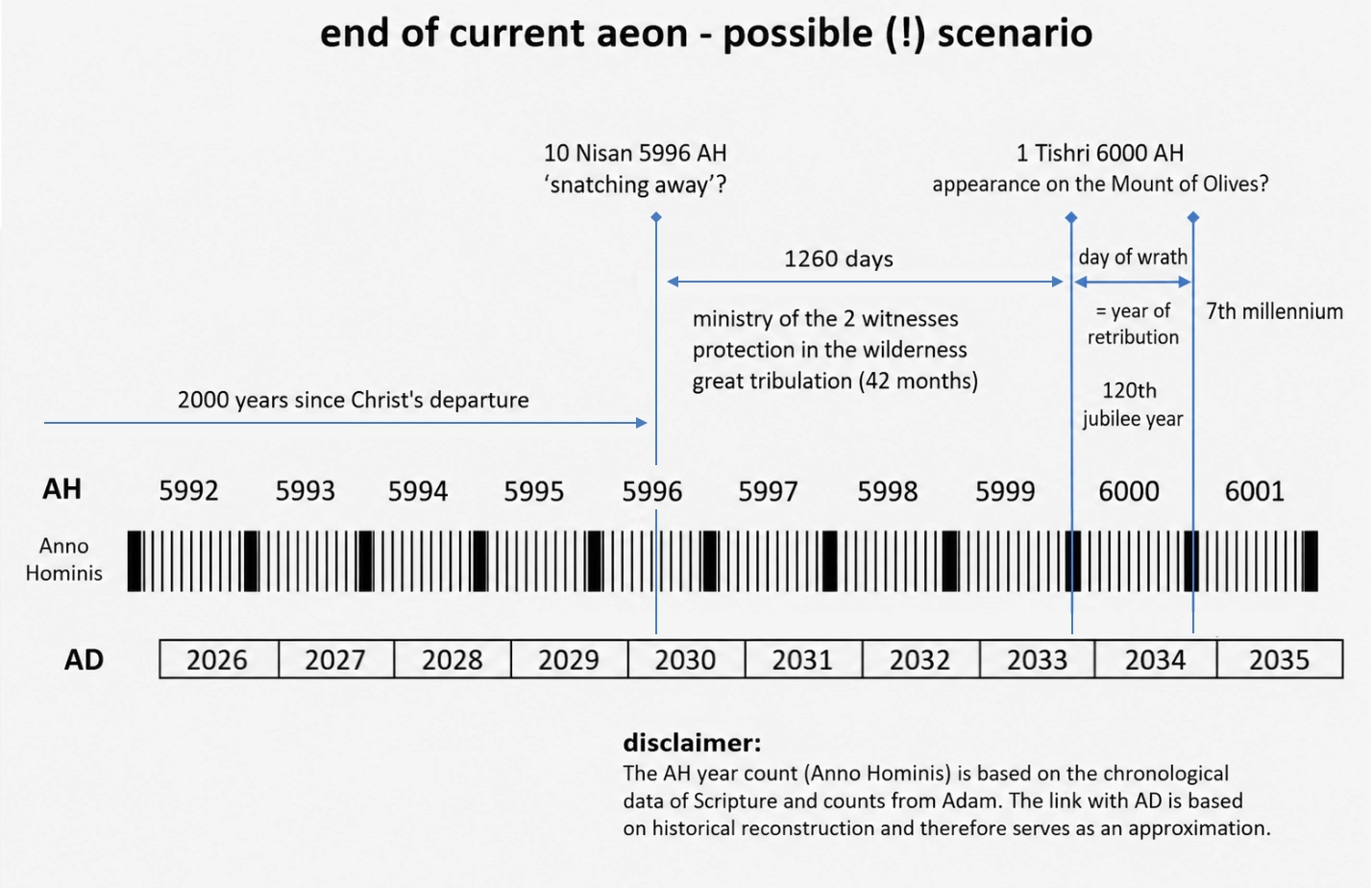
The sound of the trumpet is always connected in Scripture with the gathering together of the people. In Matthew 24 this happens at the appearance of the Son of Mankind. Appearance and gathering coincide with the trumpet blast. The festival day for this on God’s calendar is the first day of the seventh month (1 Tishri). And just as the festival days in the first month (Passover, firstfruit sheaf) received their exact fulfillment in the first coming of Christ, so it is obvious that the festivals in the seventh month will likewise be fulfilled on the appointed dates in Christ’s second coming. To begin with, His coming for Israel with trumpet blast (1 Tishri).
Ten days later, on 10 Tishri, is the Day of Atonement, Yom Kippur. That is also the date on which every fiftieth year the jubilee year begins (Lev.25:8-13). Then propitiatory shelter is made and restoration is proclaimed while the trumpet goes through the land. This points to an order. First the trumpet sounds at the appearance and the people are gathered. After that follows the moment when the jubilee year begins. Between the two lies a brief interruption. Revelation 8 speaks of silence in heaven for half an hour, after which the trumpet-judgments break loose.
the jubilee year
The jubilee year is the year of justice and restoration of rights. Possession returns and freedom is proclaimed. That is exactly what happens in this phase. Israel is restored and the nations are judged. “The day of indignation” bears the character of a jubilee year. It is the period in which God conducts the legal case for Zion (Isa.34:8).
the six thousandth year
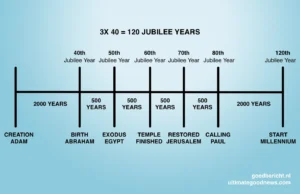
Within the Biblical time structure, as explained elsewhere, history runs toward six thousand years, corresponding to one hundred twenty jubilee cycles. The last jubilee year coincides with the year 6000 AH. The 120th jubilee year marks the transition to the seventh millennium, the sabbath rest. Chronologically too, this fits exactly.
as in the days of Noah
The flood shows a remarkable parallel with the 120th jubilee year. For the judgment of the floodwaters likewise lasted a year. To be precise: one year and ten days (Gen. 7:11; 8:14). Does the Lord not refer to “the days of Noah” as the pattern for “the days of the Son of Mankind” (Matt.24:37)?
The phase of the day of indignation ends in the decisive subjection of the nations. Satan gathers the nations for the final confrontation (Rev.16:14). There the opposition is broken. After that begins the period which Scripture indicates as “the thousand years.”
conclusion
The day of indignation is not a twenty-four-hour day. It begins at the appearance of the Messiah after Israel’s affliction and forms the necessary phase in which the nations are subjected. The prophets indicate this day as a “year of repayments.” That points to a defined year, in which God provides justice, restores His people, and judges the nations, after which the seventh millennium begins.
Delen:

Categories
Recent blog items
- Where Expectation Disappears
- Colossians 3:5 – Deaden, Then
- Colossians 3:4 – Appearing With Him In Glory
- Newsflash: Is a crisis looming over the Temple Mount?
- “Entirely Different in Freedom” [In vrijheid geheel anders] — Anastasia Zoë
- the rhythm of seven
- Newsflash: Netanyahu Wants U.S. Support Down to Zero
- a great affliction such as has not occurred