
 UltimateGoodNews
the apostasy and the restrainer
02-04-2026 - Posted by Geert-Jansummary of a lecture under the title:
before the lawless one is revealed (3) – the restrainer
Paul’s subject in 2 Thessalonians 2 is the parousia of the Lord Jesus Christ and our being assembled to Him. The term parousia literally means: presence or being present. The word does not refer to a single moment of arrival, but to the ensuing presence. The usual translation “coming” does not make this sufficiently clear. Parousia refers to the period in which the Lord is actually present.
-2 Thess. 2:1-
Our being assembled to our Lord Jesus Christ concerns the moment when the dead in Christ are rising and the living are snatched away together with them, to meet the Lord in the air. This event marks the beginning of His parousia. Paul had already earlier made this “snatching away” known to the Thessalonians as a “word of the Lord.” In 1 Corinthians 15 he speaks, in connection with this event, of a secret or hidden truth: a truth made known through him.
-1 Thess. 4:16-18; 1 Corinthians 15:51-
In Thessalonica unrest had arisen because of the thought that the day of the Lord had already set in. Such a thought assumes that the judgments were already in progress and that the lawless one would therefore already have been revealed.
-2 Thess. 2:2; Joel 2:31-
Paul mentions the apostasia as a condition that must first take place before the revelation of the lawless one. The word apostasia is a noun and literally means: standing away from, distancing. The basic meaning is fixed in the word itself. As a verb it is used for leaving, going away, withdrawing, and departing.
-2 Thess. 2:3; Acts 21:21; Joshua 22:22 (LXX)-
The concrete meaning of “departure” is determined by the context. In Acts 21:21 it concerns departure from Moses; in Joshua 22:22 (LXX) departure from the Lord. The translation “apostasy” is not a rendering of the word itself, but an interpretation of the context. The word does not state whát is being left, but thát a distancing takes place. The basic meaning remains: departure, going away, removing oneself.
-2 Thess. 2:3-
In the Greek text it does not simply say apostasia, but the apostasia. The definite article points to a known, specific event. The absence of further explanation shows that Paul refers to something already known from his teaching and that connects with the theme he is addressing.
-2 Thess. 2:1,3,5-
The context of 2 Thessalonians 2 speaks of our being assembled to Christ and immediately thereafter mentions the apostasia. In this way the word receives a concrete meaning: distancing from the earth, namely the departure of the ecclesia to be united with Him. Old English translations, such as that of Tyndale (1526) and the Geneva Bible (1560), render this as “departing” (departure). That word simply means: departure. That is exactly the apostasia: the departure.
-2 Thess. 2:1,3; 1 Thess. 4:17-
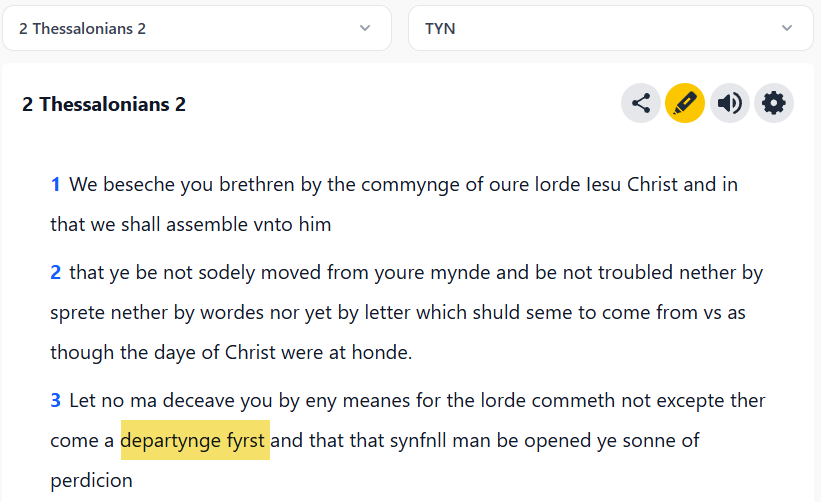
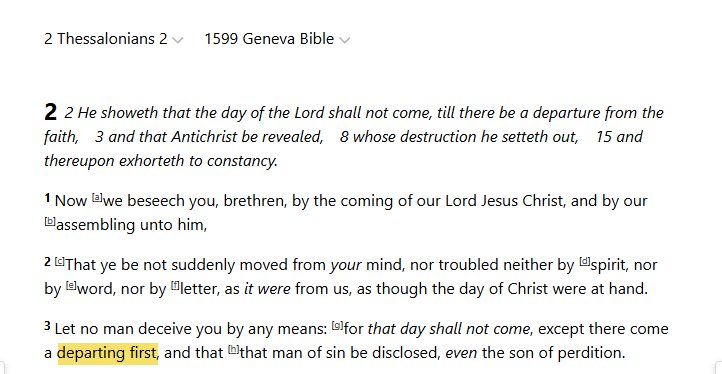
The sequence is decisive: first the apostasia and then the revelation of the man of lawlessness. This order rules out that apostasia would refer to a religious falling away or cult introduced by the lawless one. In that case the lawless one would first have to be revealed and only afterward the falling away initiated by him. The given order points to an event that precedes his revelation.
-2 Thess. 2:3-
The man of lawlessness is already present on the world stage prior to his revelation. He appears as an eleventh king within a federation of ten kings and takes over the leadership of the whole. This phase precedes the moment when he is revealed as the lawless one. His revelation follows after a deadly assault from which he recovers. From that moment on he receives his power directly from the dragon (satan).
-Daniel 7:8,24; Revelation 13:2-4; 17:8,12-13; 2 Thess. 2:3-
The revelation of the man of lawlessness becomes visible when he takes his seat in the temple of God and presents himself to be worshiped as a god. This act is referred to in Scripture as “the abomination of desolation”: an image that is set up in place of the sacrificial service. Daniel speaks of the cessation of the daily sacrifice and the setting up of this abomination, and the Lord Jesus refers to this as a decisive sign.
-2 Thess. 2:4; Daniel 12:11; Matthew 24:15; Revelation 13:14-
The revelation of the man of lawlessness presupposes the existence of a temple and a functioning sacrificial service. For he takes his seat in the temple of God and intervenes in the existing worship. Without a temple and sacrificial service, this act obviously cannot take place.
-2 Thess. 2:4; Daniel 12:11-
The sequence “first the apostasia (the departure)” belongs to the basic teaching that Paul had previously given and that was known among the believers. The confusion arose because it was claimed that Paul, in a supposed letter, taught the opposite, as if the day of the Lord had already set in.
-2 Thess. 2:2,5-
The term restraining (Gr. katechō) means to hold, holding back, keeping in check. The word denotes a force that prevents something from being revealed or breaking through. The concrete meaning of this restraint is determined by the context. The word names the operation, not the identity of what or who restrains. In 2 Thessalonians 2 it is said “what” restrains (neuter) and “he” who restrains (masculine). This alternation points to one and the same reality, indicated both collectively (“what”) and personally (“he”). The context of the chapter speaks of the presence of the ecclesia and its future departure. In that connection the restraint receives its concrete meaning: the presence of Christ in His body forms the hindrance by which the lawless one cannot be revealed.
-2 Thess. 2:1,6-7-
Lawlessness is already operating in the present time, but is revealed only when the man of lawlessness manifests himself. This revelation is being restrained until the restrainer is taken out of the midst. The apostasia and the removal out of the midst describe the same moment: the departure of the ecclesia from the earth.
-2 Thess. 2:3,7-
Delen:

Categories
Recent blog items
- Where Expectation Disappears
- Colossians 3:5 – Deaden, Then
- Colossians 3:4 – Appearing With Him In Glory
- Newsflash: Is a crisis looming over the Temple Mount?
- “Entirely Different in Freedom” [In vrijheid geheel anders] — Anastasia Zoë
- the rhythm of seven
- Newsflash: Netanyahu Wants U.S. Support Down to Zero
- a great affliction such as has not occurred