
 UltimateGoodNews
three times two thousand years (5) – from Cyrus to Christ
03-03-2026 - Posted by Geert-JanOriginally posted on March 02, 2026 – by Andre Piet
reading time: approximately 6 minutes
part 1 | part 2 | part 3 | part 4 | part 5 | part 6 | part 7 | part 8
place of this article in the series
In the previous articles it has been established that history up to Christ is arranged in fixed periods. From Adam to Abraham two thousand years pass. From Abraham another period of two thousand years runs out at Christ. This second period proves not to be one uninterrupted whole, but consists of four time spans of five hundred years each.
The first five hundred years from Abraham’s birth run out at the exodus from Egypt. Then follows a second period of five hundred years, ending with the completion of the house of God and the house of the king under Solomon. In the previous article it was demonstrated that the subsequent phase as well, from Solomon to the first year of king Cyrus, again comprises five hundred years and is presented as a closed period.
This article focuses on the final time span of this second two-thousand-year period: the five hundred years from Cyrus to Christ. The aim is the same as in the earlier articles. Not isolated events stand central, but the question whether Scripture itself delineates this period as a completed and coherent whole. In doing so, attention is given both to the historical data and to the prophetic time indications which Scripture provides.
Cyrus as the starting point of restoration
The first year of king Cyrus forms a clearly marked moment in Scripture. With his action an end comes to the seventy years of devastation pronounced over Judah and Jerusalem. The exile is not concluded silently, but explicitly brought to an end. Scripture connects this turning point with the word spoken through Jeremiah and with God’s own acting.
It is noteworthy that Cyrus is not merely mentioned afterward as a historical figure, but is named long beforehand. In Isaiah he is designated as the one through whom God will carry out His purpose:
Who says of Cyrus, My shepherd, and he shall perform all My pleasure, even saying to Jerusalem, You shall be built; and to the temple, Your foundation shall be laid.
— Isaiah 44:28
Cyrus is here connected not only with the temple, but also with Jerusalem. His action was announced beforehand. The temple may be rebuilt, the city receives new perspective and the people may return. Thus the first year of Cyrus forms a fixed chronological starting point. This period connects with what preceded it and forms the next delimited time span.
the word that went forth
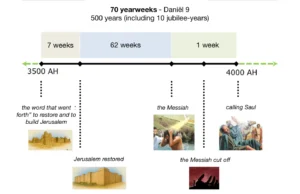
The prophecy of Daniel 9 does not place the seventy weeks in a timeless framework, but explicitly connects them with a concrete starting point. Daniel speaks of “the word that went forth” to restore and to build Jerusalem. Thus the beginning of the period is fixed.
This designation is not detached from the historical situation. Daniel prays while the seventy years of devastation are nearing their end. The restoration announced and promised under Cyrus forms the immediate background of his prayer. The “word that went forth” marks the beginning of that new phase.
It is noteworthy that Daniel expressly connects this word with Jerusalem. It does not concern the temple alone, but the city as a whole. Thus this prophetic indication closely aligns with what was said in Isaiah concerning Cyrus: that Jerusalem shall be rebuilt and the temple founded. Prophecy and history here visibly interlock. The “word that went forth” coincides with the first year of Cyrus. The restoration is therefore not filled in afterward, but designated from the outset.
the seventy year-weeks as a time frame
The seventy year-weeks of Daniel 9 connect with the sabbath structure of Scripture (Lev. 25). Seven years form a year-week, with the seventh year as a sabbatical year. After seven such sabbatical years follows a jubilee year. When Daniel speaks of seventy year-weeks, it therefore concerns seventy sabbath cycles. Within this measure the jubilee years also belong. Reckoned over seventy cycles, this concerns ten jubilee years.
Thus the seventy year-weeks comprise not merely four hundred and ninety years, but a full period of five hundred years. The prophecy reckons with the same time measure that has also become historically visible in this series.
In this way the seventy year-weeks coincide with the final five-hundred-year time span of the second two-thousand-year period. What is prophetically indicated in Daniel 9 proves to encompass the same time that is historically counted from the first year of Cyrus to Christ. The prophecy does not introduce a divergent measure, but once again confirms the fixed ordering of time.
intermediate markers within the seventy year-weeks
Within the seventy year-weeks Daniel mentions several markers that make the progress of this period visible. First seven weeks are named of Jerusalem’s rebuilding, followed by sixty-two weeks. Together they form the lead-up to the appearing of the Messiah. With these sixty-nine weeks the course is traced that runs out at His coming and public appearance.
Thereafter follows the seventieth week. This week also does not stand apart from what precedes it, but forms the concluding part of the same determined period. In Daniel 9:27 the Messiah is again spoken of. He is the One who confirms the covenant and in the midst of the week causes sacrifice and offering to cease. This cessation does not take place because the temple service factually stops, but because through His death the sacrificial service loses its significance. From that moment this sacrificial service has no validity, even though it historically continues to exist.
This is also evident from the wording itself. In the Septuagint in Daniel 9:27 the same verb is used for “cause to cease” as in Hebrews 10:9. There it is said of Christ: “He is taking away the first that He may be establishing the second.” It concerns not destruction, but setting aside through fulfillment.
The seventieth week is thereby divided into two equal halves. The first half runs out at the death of the Messiah, which takes place in the midst of the week. The second half follows and extends over a period of three and a half years. This time does not fall outside history, but finds its fulfillment in the years that follow until the rejection that culminates in the stoning of Stephen and the calling of Saul.
The final year-week stands entirely in the sign of the confirmation of the covenant by the Messiah. The causing to cease of sacrifice and offering, the division of the week and the subsequent period thus receive their place within the same historical and prophetic line. It thereby becomes clear that the seventieth week is not shifted to a distant future, but finds its fulfillment within the determined time that began with Cyrus and reaches its completion in Christ.
no interruption between the weeks
The seventy year-weeks of Daniel 9 are presented by the prophecy as one continuous period. No indication is given of an interruption between the sixty-ninth and the seventieth week. The text consistently speaks of one determined time, which runs from the starting point to its completion.
That the prophecy presents this period as a unity is also evident from the wording itself. In Daniel 9:24 it is said that “seventy weeks is determined,” where in the Hebrew a singular form is used. The weeks are not designated as separate parts, but taken together as one determined time.
The idea of a prolonged “gap” between the weeks therefore finds no support in Scripture itself. Daniel does not receive a prophecy in which time is halted or suspended. On the contrary, the succession of the weeks is described as a continuing line, in which the different moments logically follow one another.
Thus a historical reading lies at hand. The seventieth week connects with what precedes it and forms no separate future block, but completes the determined period.
Christ as the endpoint of the period
The seventy year-weeks run out at a concrete fulfillment. Daniel 9 speaks of to cover iniquity, and to seal up sin, and to bring in eonian righteousness — words that converge in the Messiah.
Thus the end of this period comes into clear focus. The prophecy does not merely point to the completion of time, but to a decisive act of God in history. With Christ not only is a time span completed, but also that which the prophecy was directed toward is realized.
In this way Christ forms the culmination of the five hundred years that begin with Cyrus. That Cyrus himself is also designated in Scripture as an anointed one (Messiah, Christ; Isa. 45:1) underscores the character of this period. In this sense Christ is not merely a figure within the timeline, but the point at which this period reaches its destination. What was prophetically announced is here fulfilled historically and substantively. Thus the second two-thousand-year period is brought to completion.
the sealing of vision and prophecy
In Daniel 9:24 one of the purposes of the seventy year-weeks is mentioned as “to seal vision and prophecy” for Daniel’s people and the holy city. This sealing does not indicate confirmation, but closure. That meaning also appears in Daniel 12:9, where the words are sealed in the sense of shutting up and concealing. The prophecies are spoken and fulfilled, yet their meaning is kept hidden from the people (compare Isa. 29:9–12).
Thus this sealing marks a clear transition. The period in which these prophecies gave direction to Israel comes to an end. What follows is not a new prophetic interpretation, but a time in which understanding is shut up. In this way the sealing of vision and prophecy forms a fitting conclusion to the five hundred years delineated here.
Delen:

Categories
Recent blog items
- Where Expectation Disappears
- Colossians 3:5 – Deaden, Then
- Colossians 3:4 – Appearing With Him In Glory
- Newsflash: Is a crisis looming over the Temple Mount?
- “Entirely Different in Freedom” [In vrijheid geheel anders] — Anastasia Zoë
- the rhythm of seven
- Newsflash: Netanyahu Wants U.S. Support Down to Zero
- a great affliction such as has not occurred