English Blog
three times two thousand years (1) – Adam to Abraham
24-02-2026 - Posted by Geert-JanOriginally posted on February 20, 2026 – by Andre Piet
reading time: approximately 8 minutes (extended study)
part 1 | part 2 | part 3 | part 4 | part 5 | part 6 | part 7 | part 8
why a Biblical chronology?
Chronology is the study of the reckoning of time. In the Bible, time is not a neutral background, but part of God’s speaking itself. Scripture not only records what happens, but deliberately places events in time. Especially in the Messianic line, ages and periods are transmitted with precision. In this way, the Bible itself provides the possibility of tracing human history in time.
This article forms the first part of a series in which it is set forth that Biblical history up to the Messianic kingdom is divided into three periods of two thousand years each. This division is not imposed from the outside, but follows from a careful counting of the Biblical data itself. In this first part it is demonstrated that the period from Adam to Abraham amounts to two thousand years.
starting point and purpose
The purpose of this article is not to apply a scheme to history, but to count what Scripture itself provides. That requires careful handling of the data. When the Bible counts, it does so inclusively; when it mentions ages, this calls for responsible processing. Only along that path can it be established whether the first period of human history indeed reaches a boundary after two thousand years.
only the Messianic line is counted
In Genesis, not all humanity is followed chronologically. Only in the line through which God’s promise runs are ages and periods mentioned. In Genesis 5 ten generations are listed, from Adam to Noah, each time with both the age at begetting and the remaining lifespan. In Genesis 11 we see the same pattern in the line from Shem to Abraham. Together, these data form a closed timeline.
It is striking that this chronological precision is absent in other genealogies. In Genesis 4, the line of Cain, no ages are mentioned. In Genesis 10, where the nations are described, every reckoning of time is lacking. The Bible does not trace the development of humanity as a whole here, but marks exclusively the line in which God’s dealing continues. Precisely this limitation underscores the weight attributed to these time data.
inclusive counting
The Bible employs a different manner of counting than we are accustomed to. In Scripture, years are counted inclusively. This means that the first year of life begins at birth and is counted as year one. Whoever is “in his thirtieth year” has twenty-nine complete years behind him. This manner of counting applies not only to ages, but also to days and periods.
This inclusive counting is decisive for a Biblical chronology. Whoever unwittingly applies modern, exclusive counting shifts the timeline and arrives at seemingly neat, but incorrect results. The chronological data in Genesis can only be processed responsibly when they are read as they are intended.
counting from the middle of the year
When the Bible states that someone begot a son at a certain age, it does not indicate at what moment within that year this took place. This means that within each stated year a margin is present. Whoever ignores this margin and fixes all begettings at an exact moment introduces a false precision and assigns to the data an accuracy that Scripture does not give.
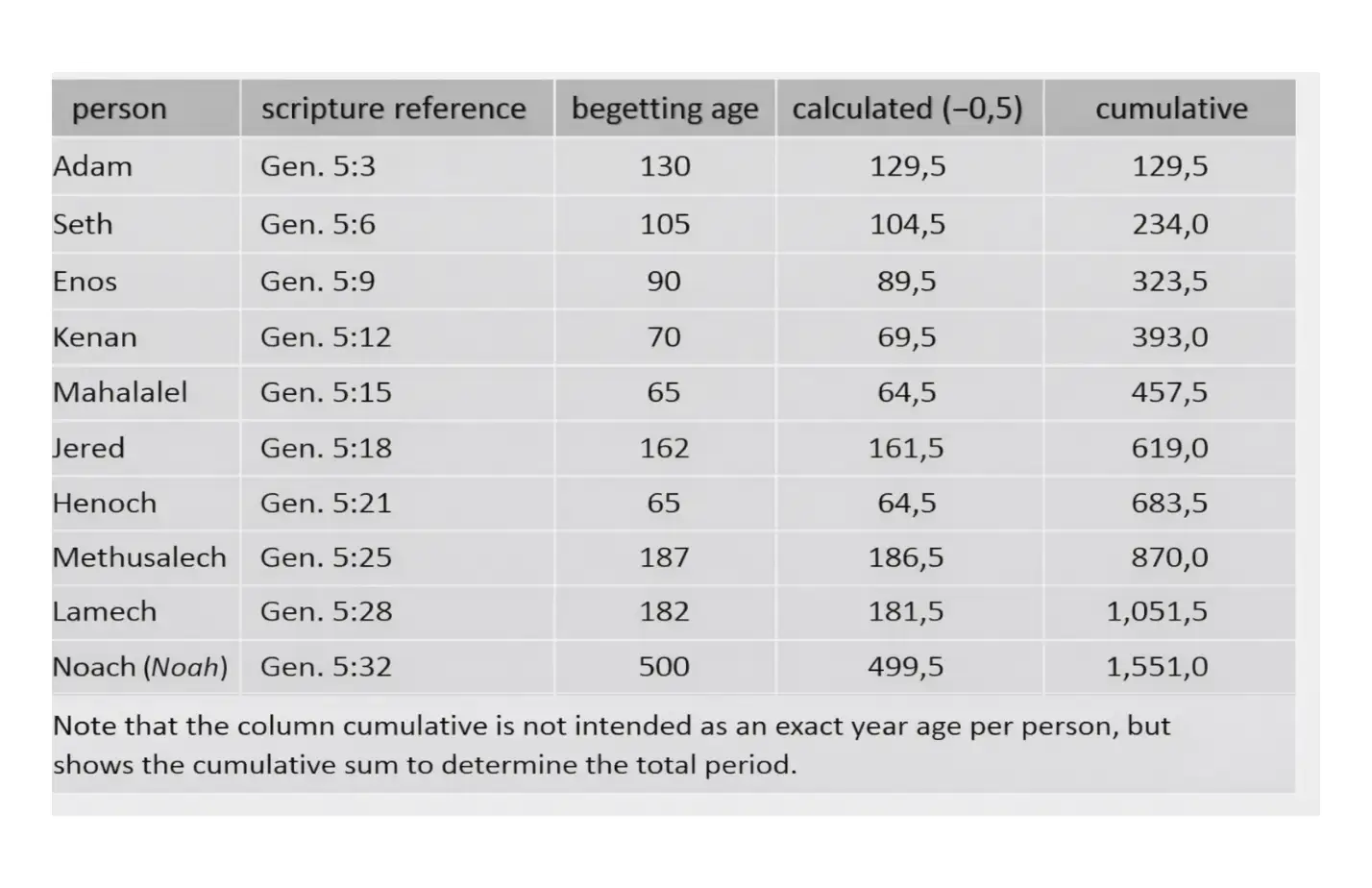
In order to process this uncertainty responsibly, the calculation is made from the middle of the year. The stated ages are therefore reduced by half a year. This approach is suitable for determining the total period, but not for exactly dating individual generations. The purpose is not to establish individual birth moments, but to approach the total span of time as realistically as possible.
beginning and end as fixed points
With this manner of calculation, no exact years are mentioned per generation or per patriarch. That is not a shortcoming, but a deliberate choice. The intervening years are approximated, not fixed. In this way it is prevented that a precision is assigned to individual lives which the text itself does not offer.
The timeline, however, does have a fixed beginning and a fixed end. The beginning lies at the creation of Adam, with which human history commences. The end of this first period is marked by explicit biblical data: the established lifespan of Noah and the moment when the line runs out into Abraham. These beginning and end points are fixed. In between, the time is carefully counted, with the result that the period from Adam to Abraham comprises two thousand years.
from Adam to the flood
When the data of Genesis 5 are processed according to the adopted starting points, a closed timeline arises from Adam to the deluge. Ten generations are mentioned, with for each generation both the age at begetting and the remaining lifespan. There are no gaps and no overlapping lines. Scripture does not leave this period open, but delineates it completely.
The exceptionally high ages make this early history difficult for us to imagine. Yet the text is consistent and sober in this. The stated ages are not symbols, but indications of time. Precisely because they are transmitted so accurately, the total period from Adam to the days of Noah can be established, without having to assume exact calendar years for each patriarch.
Noah as a hinge figure in time
Noah occupies a unique place in the biblical timeline. He belongs to the world before the deluge, yet he also lives for centuries afterward. Thus his life connects two distinct eras. Scripture emphasizes this by mentioning both his lifespan and the decisive moments in his life with precision.
The deluge falls in the middle of Noah’s life. In this way Noah represents both the end of the old world and the beginning of the new. Chronologically he is not a marginal figure, but a hinge point. Through his life the reckoning of time remains uninterrupted, while history itself takes a radical turn.
the beginning and end of the deluge
Scripture dates the beginning of the deluge precisely. In the six hundredth year of Noah’s life, in the second month, on the seventeenth day, the springs of the vast submerged chaos burst forth. Thus not only the event itself is fixed, but also its place within the timeline.
The end of the deluge is also explicitly marked. In Noah’s six hundred first year it is described that the waters have dried up and that the covering of the ark is removed. This moment marks not merely the cessation of the water, but the beginning of a new phase in human history. The beginning and end of the deluge thus form fixed reference points within a continuous reckoning of time.
time structure before the institution of the jubilee
The jubilee is made known as an institution only in the days of Moses. In the law, the fifty-year cycle is given a fixed place and a clear function. Yet this does not mean that this measure originated only then. When the early biblical chronology is followed, it appears that the reckoning of time from Adam onward already proceeds according to fixed structures.
This structure is not presented as a commandment and in this early period has no ritual or legal significance. It becomes visible in the way the years join together. The later institution of the jubilee does not stand apart from this, but confirms what was already embedded in time itself.
Noah’s lifespan in cycles
Noah’s birth does not fall on a cycle boundary and therefore cannot be designated as a “jubilee year.” It is different with the further marking points in his life. His total lifespan of nine hundred and fifty years is explicitly stated and proves to comprise exactly nineteen fifty-year cycles. His year of death likewise forms a fixed chronological reference point.
From this it also follows that the end of the deluge, which falls in the six hundred first year of Noah (-Gen. 8:13-), coincides with a “jubilee year.” Not as a legal institution, but as a recognizable time structure within the chronology.
from the deluge to Abraham: continuation of the same measure
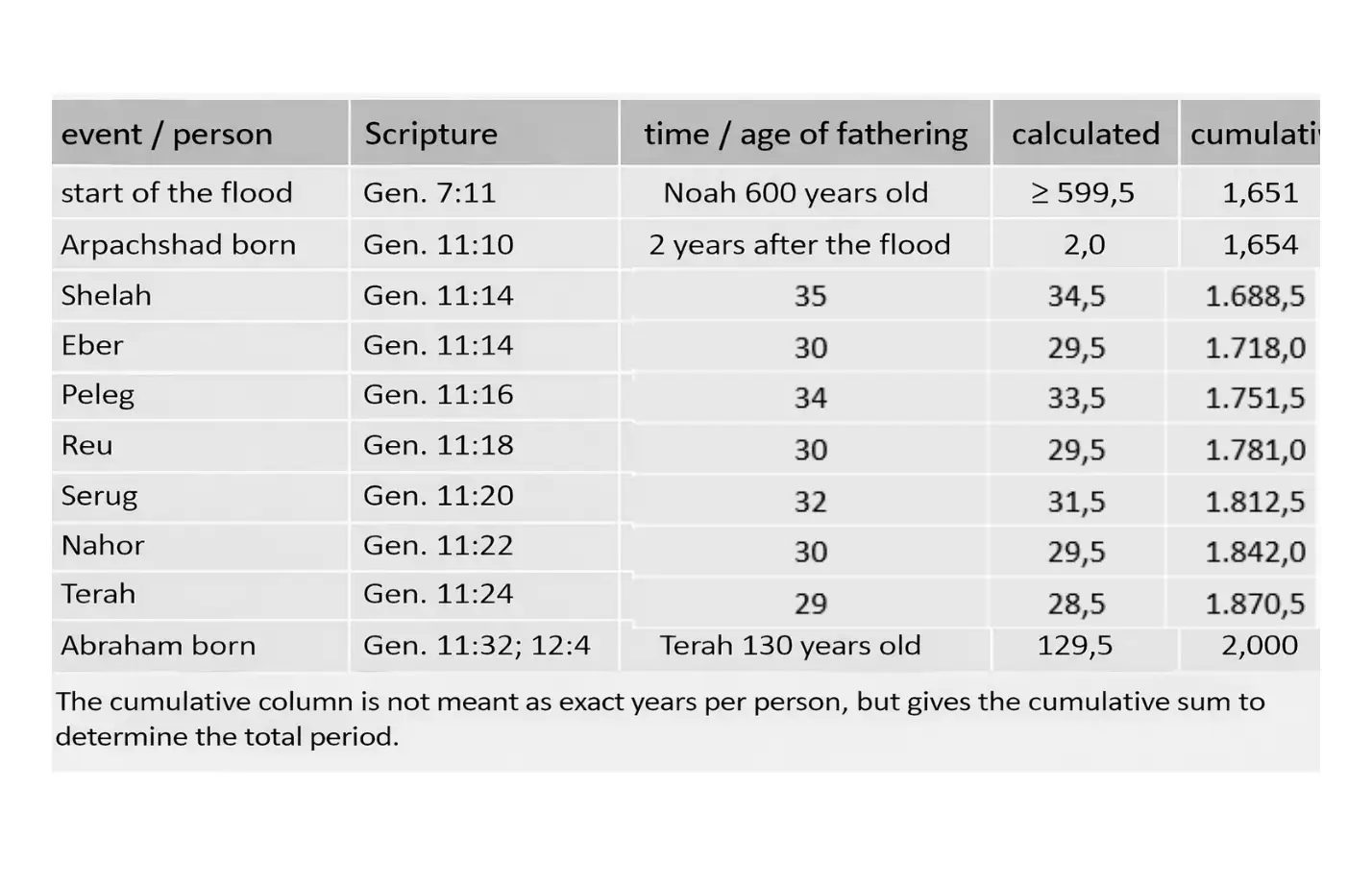
After the deluge the reckoning of time continues along the same line. In Genesis 11 ages and periods are again mentioned, now in the line from Shem to Abraham. The structure is identical to that of Genesis 5. Thus it becomes clear that the chronology does not begin anew, but continues.
This period also connects to the same measure. No new time structure is introduced and no recalibration takes place. The transition to Abraham occurs within the same ordered time.
the year 2000 AH (since Adam): end and beginning
When the total period from Adam to Abraham is surveyed, a clear boundary point is reached. The timeline culminates in the two thousandth year since Adam. With this, the first period of human history is concluded.
It is remarkable that Noah’s life also reaches this same year. He died in his nine hundred fiftieth year of life, which coincides with the year 2000 AH. Thus the death of Noah and the birth of Abraham coincide at one chronological boundary point.
no missing links
It is sometimes asserted that the genealogies of Genesis would be incomplete. Reference is then often made to differences with other registers, such as in Luke 3. From such differences the conclusion is drawn that the chronology would be open.
This conclusion is not justified. Scripture knows multiple forms of descent and presents the data in Genesis 5 and 11 precisely as closed. This is evident from the fact that for each generation both ages and remaining years of life are mentioned. These registers are intended for the reckoning of time and leave no room for missing links.
conclusion: the first period of 2000 years
The first two thousand years of human history do not form a loose succession of ages, but a coherent whole. From Adam onward time is carefully counted and ordered. The deluge constitutes a break in history, but not in the reckoning of time. Noah stands as a hinge figure in the midst of this transition.
With Abraham a new phase is inaugurated, precisely at the boundary point of this first period. Thus it is established that the time from Adam to Abraham comprises two thousand years. This forms the first building block for the further division of Biblical history. In the next part it will be examined whether the subsequent period as well, from Abraham to the Messiah, follows the same measure.