
 UltimateGoodNews
Heaven in the midst
10-04-2026 - Posted by Geert-JanOriginally posted on January 08, 2011 – by Andre Piet
in the midst of the waters
Whoever forms a picture of what Genesis 1 says about the position of heaven makes a remarkable discovery. In 1:2 it is stated: “darkness was on the surface of the submerged chaos” and “the spirit of Elohim was vibrating over the surface of the waters.” Then in verse 6 God brings the expanse into being. Where? “In the midst of the waters,” that is, in the midst of the waters with which the world was covered. If we look at what follows in Genesis 1, it appears that the expanse (= heaven; 1:7) includes the entire celestial space. For in Genesis 1:14-16 we literally read of “the luminaries in the expanse of the heavens.” On the one hand, then, the sun, the moon, and the stars in the expanse, and on the other hand “the waters above the expanse.” In other words, “the expanse of the heavens” is surrounded by water, above and below.
Proverbs 8:27 refers to the same event as Genesis 1:6. There we read that when God prepared the heavens, He inscribed a circle on the surface of the abyss*. The surface of the abyss is circular, and according to Genesis 1 heaven is located not outside but “in the midst” of that circle (= the waters).
*abyss here is the same word as in Genesis 1:2, where it is translated as “submerged chaos.”

A circle on the surface of the ocean. On the left our familiar conception, and on the right the conception in Genesis 1.
This worldview is remarkable for two reasons. In the first place because the Biblical conception implies that the world is spherical, in contrast to the primitive idea of a flat earth from which one could fall off. But at least as striking is that we seem to be located not on the outside edge but on the inside of the globe…
heaven as an outstretched tent
Before we go into this latter point more closely, we must first realize the importance of “the expanse in the midst…”. For that we need to understand why heaven is called “expanse.” The word “expanse” is taken from the image of a tent being stretched out (Isa. 40:22). Psalm 19:4 also says that God has stretched out a tent in the world (> the expanse). In Biblical symbolism heaven is a tent. God’s tent, the tabernacle, was therefore a copy of the heavenly realities (Heb. 9:24). And how was the tabernacle positioned? The tribes of Israel were stationed around the tabernacle (Num. 2:2). So here too, just as in Genesis 1: the outstretched tent (> the expanse) in the midst! It demonstrates how God places His dwelling place centrally.
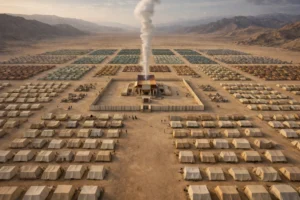
The Tabernacle in the midst
By physically situating heaven in the midst of the world, Genesis 1 presents a theocentric worldview. The dwelling place of God in the midst. Graphically represented:
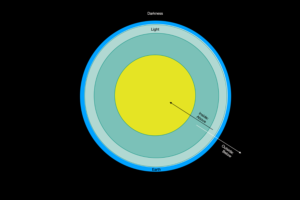
a theocentric worldview: upward = inward.
inversion
Meanwhile, the question presses itself upon us: how does this conception (the celestial space inside the globe) relate to the scientific conception? God’s observation seems to be exactly the reverse of ours. It turns the worldview familiar to us inside out. What, according to the scientific model, is the outermost (beyond the stars), is in the Biblical conception precisely the innermost. Formulated mathematically: the Biblical conception is an inversion (= reversal) of the scientific conception and vice versa. Let me work that out briefly.
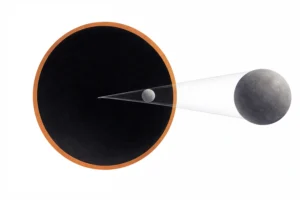
the gray sphere inside is an inversion of the gray sphere outside
In an inversion-world, everything becomes infinitely smaller toward the center. Atoms, astronauts, spaceships, but also measuring instruments, everything shrinks toward the midpoint. Another consequence of inversion is that light does not travel in a straight line, but in a circular path.
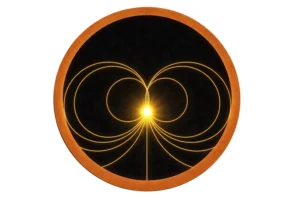
the sunlight in a hollow world
The remarkable thing about inversion is that all phenomena in the Copernican model appear in exactly the same way for an observer in the inversion model. That is to say, even in a hollow world, an astronaut, for example, sees the earth from space as a sphere. Because space curves, he looks, as it were, through a fisheye lens at the earth.
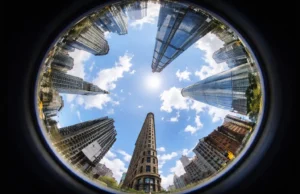
as in a fisheye lens
In an inversion-world too, a rocket must travel nearly 400,000 km from the earth to reach the moon. That seems bizarre, but the explanation is that everything shrinks toward the center, so the spaceship and the kilometers also become ever “shorter.” Thus celestial space, despite its limitation, is still immeasurable (Jer. 31:37. Thus says YHWH: If the heavens above could be measured, and the foundations of the earth below could be investigated, then I Myself shall reject all the seed of Israel on account of all that they do, averring is YHWH).
Incidentally, eccentric as a concave earth may seem, its basic ingredients are all known in science. Science too speaks of curved space and a limited and spherical universe. And Einstein already stated that if one were to aim an infinitely strengthened telescope straight upward, one would observe the other side of the world. On a globe that seems a bizarre notion, but in a globe it is nothing more than self-evident.
The late Prof. H. S. M. Coxeter, professor of mathematics at the University of Toronto and expert in the field of geometric inversion, was asked whether you can prove whether we live on a convex or concave earth. His answer was:
I couldn’t think of one. A rocket shot, an eclipse, the Foucault pendulum, the Coriolis effect—every observation we make on the outside of the earth has an exact duplicate version on the inside of the earth. There is no way to tell which is the truth.”
OMNI Magazine October 1983
side by side
The conception of the earth as a ball in space is based on our observation and forms the simplest way to explain phenomena. At the same time, there is the Biblical conception of an earth with heaven in the midst. That is God’s observation. At most foolish from the perspective of the world (cf. 1 Cor. 1:20: “…Does not God make stupid the wisdom of this world?”) As the above-mentioned popular scientific article judged: “a maddening theory…”. But, it added: “...that can’t be disproved”.
theocentric!
The concept of a convex earth is valid within the scientific enterprise, but for whoever believes Scripture, God’s point of view goes beyond that. For Him, heaven is in the midst—that is to say: a theocentric worldview. Wherever one points upward on earth, one points to the dwelling place of God! And is living nature not also a wonderful confirmation of this concept? Does not everything there point to the middle? Is not everything an expansion from the center? Whether we see a sliced kiwi, an orange, a melon, or an egg. Or a dandelion, a daisy, the rings of a tree, or a spider’s web. The core or essence is always located in the center. Are they not all “artistic” expressions of the Creator of heaven and earth?

images of heaven and earth
—————————————————
LINKS,
for those who would like to become somewhat more acquainted with the heaven-centered worldview (or geo-cosmos / cellular cosmos / concave earth). Let the reader judge for himself.
Blogpost: The expanse in the midst
the hollow earth: a maddening theory that can’t be disproved (OMNI Magazine October 1983)
The Inversed Earth Hypothesis
inside-out universe
turning the universe inside-out (philosophical / conceptual approach)
Professor Sexl on the geocosmos model (Google translated from German into Dutch)
The Biblical worldview (NBC, Ab Klein Haneveld)
inversion-tool (tool showing how geometric inversion in a circle works)
Hollow Earth Applet
Delen:
Categories
Recent blog items
- Where Expectation Disappears
- Colossians 3:5 – Deaden, Then
- Colossians 3:4 – Appearing With Him In Glory
- Newsflash: Is a crisis looming over the Temple Mount?
- “Entirely Different in Freedom” [In vrijheid geheel anders] — Anastasia Zoë
- the rhythm of seven
- Newsflash: Netanyahu Wants U.S. Support Down to Zero
- a great affliction such as has not occurred