
 UltimateGoodNews
“The Expanse In The Midst” (I)
14-04-2026 - Posted by Geert-JanOriginally posted on February 01, 2011 – by Andre Piet
In the modern worldview, the earth is a celestial body that floats through outer space as an insignificant little planet. It corresponds to the impression we get when we look at the earth from space. But is this perception also the reality as God sees it? Or is it merely “what is before the eyes” for man? How does the Bible present heaven and earth to us?

Let us line up a number of biblical facts.
#1 The Earth is not part of heaven
In the Bible, the earth is not a heavenly body but is consistently distinguished from heaven.
In the beginning Elohim created the heavens and the earth…
Gen. 1:1
Heaven and earth relate to each other as, respectively, below and above.
… as the heavens are above the earth.
Deut. 11:21For He looks unto the ends of the earth; under all the heavens He sees.
Job 28:24
#2 The expanse includes the celestial bodies
And Elohim said: Let there come to be luminaries IN the expanse of the heavens…
Gen. 1:14… and let them come to be for luminaries IN the expanse of the heavens to give light on the earth. And so it became. And Elohim made the two great luminaries, the greater luminary for the rule of the day and the smaller luminary for the rule of the night, and the stars.
Gen. 1:15, 16
The “expanse” is often understood to mean the atmosphere. It is sometimes even translated that way. Wrongly so, for the expanse (= the heavens; Gen. 1:8) includes not only the space where “the birds of the heavens” fly (Gen. 1:26), but also the space of “the stars of the heavens” (Gen. 22:17) and even the throne of God (Ps. 11:4).
Genesis 1 distinguishes, on the one hand, the celestial bodies IN the expanse and, on the other hand, “the waters ABOVE the expanse.” If the expanse were the atmosphere, then the waters would be in the expanse, while the light-bearers would be located above the expanse.
#3 The expanse is located in the midst of the world
The first time Genesis 1 mentions the waters is in verse 2: “… and darkness was on the surface of the submerged chaos, and the Spirit of Elohim was vibrating over the surface of the waters.” These waters are mentioned a second time in verse 6:
And Elohim said: Let there come to be an expanse in the midst of the waters, and let it come to be separating between waters and waters. And Elohim made the expanse, and He separated between the waters that were under the expanse and between the waters that were above the expanse. And so it became.
Gen. 1:6, 7
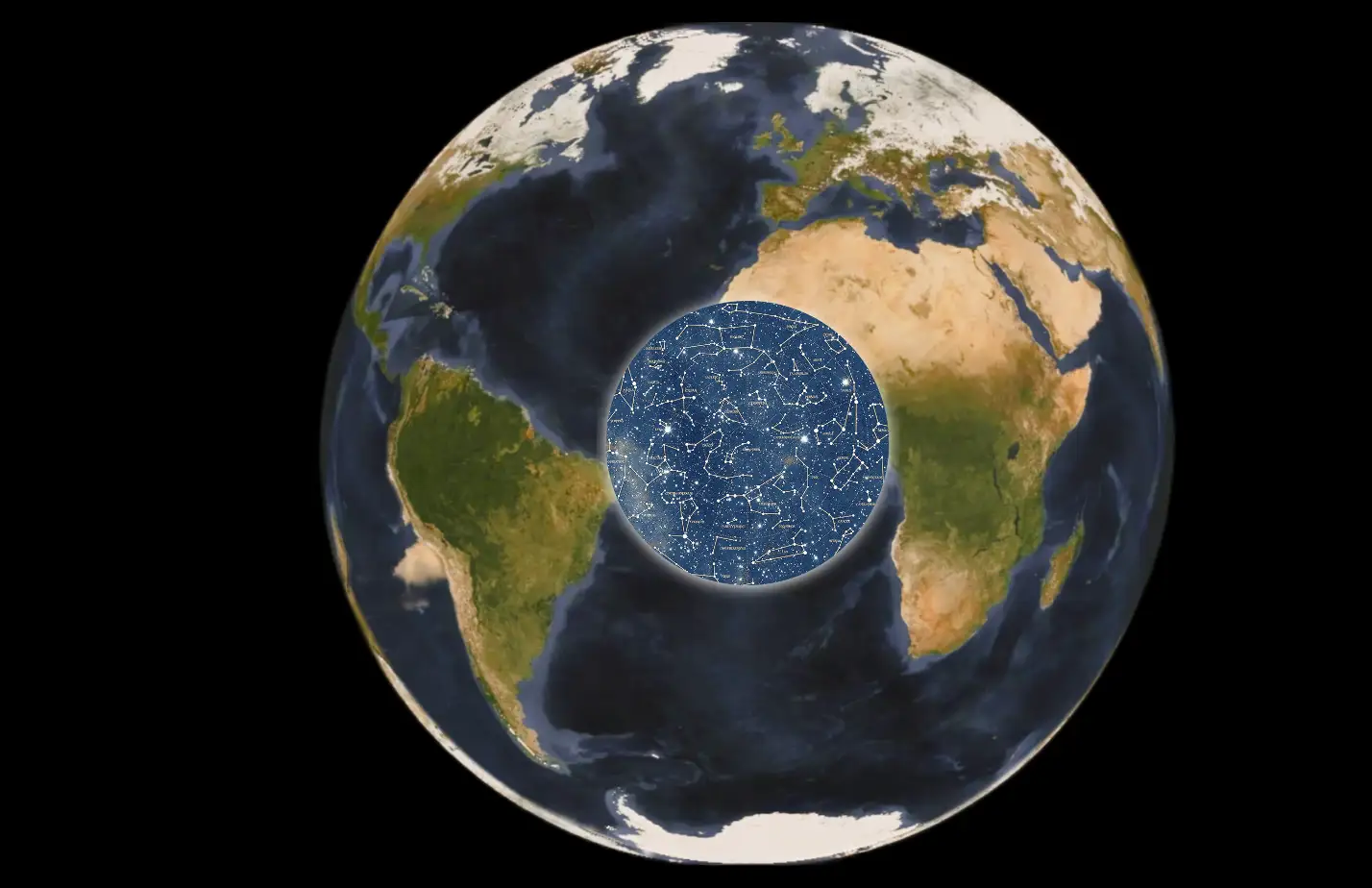
Just imagine it: the world is covered with water, and then God causes the expanse to come into being… IN THE MIDST OF THE WATERS, surrounded both above and below by water. If we draw out these words in Gen. 1:6, this picture emerges:
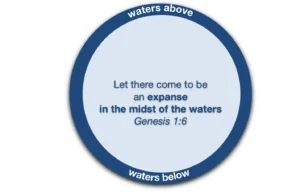
The “waters above the expanse” here are nothing other than the waters on the other side of the world. They are mentioned here in order to localize heaven: in the midst.
That the water surface, as in the illustration above, is indeed round is shown by Proverbs 8:27.
When He (=GOD) established the heavens, I was there; when He decreed a circle on the surface of the abyss…
Prov. 8:27
The preparing of the heavens is in this verse connected with the circle on the surface of the ocean*. With heaven (as we saw) in the midst.
*ocean > Hebr. ’tehom’; in Gen. 1:2 translated “the submerged chaos”
In summary: in the opening verses of the Bible, God presents Himself as the Creator of heaven and earth and as the One Who physically placed His “tent” (the expanse, heaven) in the midst, that is, in the midst of the waters that covered the world.
#4 Heaven is stretched out
… He is stretching the heavens as a canvas…
Psalm 104:2 NBG
… He stretches out the heaven as a curtain….
Ps. 104:2 Statenvertaling
He Who is sitting over the circle of the earth, and its dwellers are as grasshoppers; He Who stretches out the heavens as a thin gauze, and spreads them out as a tent to dwell in.
Isa. 40:22
The word “expanse” is, of course, derived from the verb “to stretch out.” Time and again, Scripture speaks of God stretching out or spreading out the heaven. For example, like a tent. In the words “spread out” and “stretch out,” the idea is implied that room is being made.
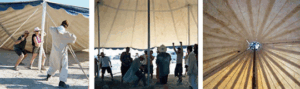
The verb “to stretch out” is also used in Ps. 104:2. Heaven is stretched out like a curtain, as the Statenvertaling correctly renders it. It suggests that space is stretchable. But if space is stretchable, then this also applies to the “yardstick” by which it is measured.

Thus says YHWH: If the heavens above can be measured, and the foundations of the earth beneath can be searched out, I also shall reject all the seed of Israel for all that they have done, averring is YHWH.
Jer. 31:37
The word for stretching out is also used for the lengthening (= stretching out) of the shadow (Ps. 109:23). When a shadow is lengthened, optical illusions arise. Things look smaller or larger than they are, and real proportions disappear through perspective.

Could you with Him have spread out the atmosphere in the skies, Steadfast as a MIRROR that is solidly set?
Job 37:18
#6 The Tabernacle is a type of heaven: set up in the midst
For Christ entered not into holy places made by hands, antitypes of the true, but into heaven itself…
Heb. 9:24… which is entering into that within the curtain, where the Forerunner entered for our sakes, Jesus…
Heb. 6:19, 20
Heaven as God’s stretched-out tent is an important given in biblical symbolism. A large part of the expositions in the letter to the Hebrews is based on it. The tabernacle was God’s sanctuary, a tent that was a type of heaven. It was the “expanse” in which He dwelt.
The sons of Israel shall encamp … at a distance they shall encamp around the tent of appointment.
Num. 2:2The tent of appointment now … shall set out in the midst of the camps…
Num. 2:17
Essential to the arrangement of the encampment in the wilderness was that everything should be grouped around the tabernacle, the tent of God. The tabernacle was to be the center. Spiritually, but physically as well. Just as once “the tree of life” had been positioned “in the midst” of the garden of Eden (Gen. 2:9).
The placing of the “expanse in the midst” in Genesis 1 betrays a characteristic biblical truth: God’s seat, the stretched-out tent, is placed in the center.
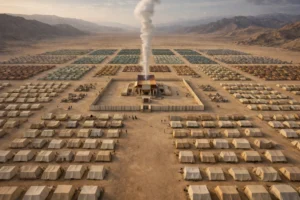
#7 GOD is throned above the circle of the Earth
It is He Who sits over the circle of the earth… Who is stretching out the heavens like thinnest gauze And is billowing them out like a tent to dwell in.
Isa. 40:22 (see also: 1 Kings 22:19; Ps. 11:4; Matt. 5:34; 23:22; Acts 7:49)
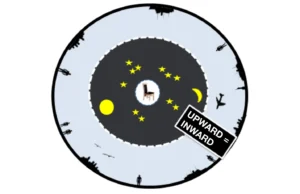
If heaven is in the midst, then the throne of God is, wherever on earth we may be, always above us. Whether we point upward in New Zealand or in the Netherlands, by definition we are pointing to one central point. God’s throne is established (Ps. 93:2) and central in creation. This may rightly be called a universe: everything is turned toward one (uni = one, versum = turned).
Typology
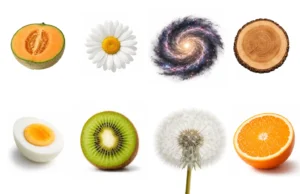
For whoever recognizes the force of the biblical arguments above, living nature is a splendid illustration of the above. Does not everything in nature point to the middle? Everything concentrates toward the center and, seen from the center, space is expanded. Whether we see a sliced kiwi, an orange, a melon, or an egg. Or a dandelion, a daisy, the rings of a tree, or a spider web. The core or essence is always in the center. Are they not just so many “artistic” expressions of the Creator of heaven and earth?
See also:
The Expanse In The Midst: Part 2
Delen:
Categories
Recent blog items
- Where Expectation Disappears
- Colossians 3:5 – Deaden, Then
- Colossians 3:4 – Appearing With Him In Glory
- Newsflash: Is a crisis looming over the Temple Mount?
- “Entirely Different in Freedom” [In vrijheid geheel anders] — Anastasia Zoë
- the rhythm of seven
- Newsflash: Netanyahu Wants U.S. Support Down to Zero
- a great affliction such as has not occurred