English Blog
Do Messiah-believing Jews have to keep the law?
07-04-2026 - Posted by Geert-JanOriginally posted on April 04, 2026 – by Andre Piet
Summary of the lecture under the title:
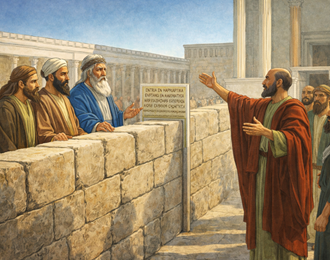
Paul in the Lions’ Den
In Acts 21, Paul arrives in Jerusalem shortly before the feast of Pentecost. He comes there with a clear purpose: he brings the proceeds of a collection for the believers in Judea. At the same time, he knows that imprisonment and much affliction await him there.
-Acts 21:10-11; Romans 15:25-26-
The day after his arrival, Paul visits James with his companions, and all the elders are present. This is an official gathering of the leadership in Jerusalem. Paul then reports on his ministry among the nations. He tells in detail what God has done. The emphasis is on God’s work, not on human achievement.
-Acts 21:18, 19; Romans 15:18-19-
Paul’s ministry among the nations was confirmed in unmistakable fashion by miracles, powers, and signs. These were not intended primarily for the nations, but served as visible proofs for Israel that Paul had been sent by God and that his ministry was being confirmed by God Himself. Therefore they glorified God when they heard this.
-Acts 15:12; 2 Corinthians 12:12; Romans 15:18-19-
The response to Paul’s testimony is remarkable. There prove to be “tens of thousands” (myriads) of Jews who have become believers. So this is a very large Messiah-believing Jewish community in and around Jerusalem. Of this group it is said explicitly that they are all “zealous for the law.” The entire community was characterized by this zeal.
-Acts 21:20; Acts 15:5-
Paul’s bad reputation among the Messiah-believing Jews in Jerusalem was not based merely on rumors about him. Luke uses a word from which our understanding “catechesis” (Gr. kat-echeo) is derived: top-down instruction that would “echo” through the community. A harmful picture of Paul was being spread systematically.
-Acts 21:21; Luke 1:4; Galatians 1:22-23-
The instruction about Paul portrayed him as someone who was departing (Gr. apostasia) from Moses. They accused Paul of teaching the Jews in the diaspora that they should not circumcise their children or walk according to the customs.
-Acts 21:21-
The accusation was that Paul taught the Jews among the nations apostasy from Moses, by saying that they should not circumcise their children and should not walk according to the customs. That accusation is incorrect. Repeatedly it is testified explicitly that Paul, even after his calling on the road to Damascus, himself walked according to the Jewish customs. More than that, it was at his own initiative that Timothy (who had a Jewish mother) was circumcised.
-Acts 21:21; Acts 20:16; Acts 18:18; Acts 16:3-
That Paul taught Jews among the nations that circumcision and walking according to the customs are not obligatory, on the other hand, is true. He did not impose Jewish practice on them, but left them free in it and also taught that freedom emphatically. For zealots for the law, that freedom was taken as apostasy from Moses.
-1 Corinthians 9:20; Galatians 5:1; Galatians 2:4-5-
To contain the tension that had arisen, James makes a concrete proposal. Paul must publicly show that he himself keeps the law by taking part in a vow. In this way Paul would demonstrate that the accusations circulating about him were groundless and that he himself went along with keeping the law.
-Acts 21:23-24-
Paul agrees to James’s proposal without objections and acts accordingly. Why not? He did not compromise himself by demonstrating a Jewish way of life. He always did that already. But he will have been aware that in this way the real problem was not being solved. For it was not Paul’s way of life, but his message, that formed the stumbling block.
-Acts 21:26-28-
James makes an important distinction between believers from among the Jews and believers from among the nations. Believers from among the nations are not placed under the law; this had already been established earlier in the Jerusalem meeting, where only their position was under discussion. The four decrees (concerning idols, prostitution, what is strangled, and blood) that apply to the nations reach back to universal rules that already applied before the law of Moses.
-Genesis 9:4; Genesis 2:24; Acts 15:19-20-
For believers from among the Jews, keeping the law was not under discussion, but was self-evident. And precisely there the tension arises. For where James and his people proceed from continuation of the law and the customs for the Jews, Paul breaks through that and teaches that they too are free in this.
Paul’s message concerns his unique calling as “apostle of the nations.” To him “the evangel of the foreskin” has been entrusted. Paul is a Jew, but he speaks on behalf of the nations. And from that position he addresses Israel. To Paul had been entrusted the thankless task of telling Israel that God had sent salvation to the nations.
-Galatians 2:7-8; Acts 28:28; 22:17-22-
God is presently forming for Himself, apart from Israel, a people from among the nations. By saying this to Israel, Paul made them jealous and angry. In the current era Israel is lo-ammi. Not My people. Paul speaks explicitly about this: he glorifies his ministry among the nations in order to stir up the jealousy of his fellow countrymen.
-Romans 9:25; 10:19; Romans 11:13-14-
During the Acts period, two realities exist side by side. A large Messiah-believing Jewish community that keeps the law, and Paul’s ministry among the nations in which keeping the law (circumcision, sabbath, festivals, customs) is totally not an issue. The first group, under the leadership of James, Peter, and John, counted on Israel’s repentance in those days, while Paul knew that this definitely would not take place.
-Acts 21:20; Galatians 2:9; Acts 3:19-21; Acts 22:18-
The aim of Paul’s ministry is not to save Israel as a people, but only some. Israel as a people will indeed be saved entirely, but not before the fullness of the nations has entered. Not through proclamation of the evangel, but because the Deliverer will come out of Zion.
-Romans 11:15; 25,26-
The answer to the question asked in the title is that keeping the law is not a norm for Messiah-believing Jews. Today God is forming for Himself, apart from Israel, a people from among the nations. The law of precepts plays no role in that. What remains is freedom.
-Ephesians 2:14,15-