
 UltimateGoodNews
eternal punishment not a final destination
14-01-2026 - Posted by Geert-JanOriginally posted on August 29, 2008 – by Andre Piet
In today’s Nederlands Dagblad, Wim Hoogendijk gives an excellent response to the criticism that was previously raised in the newspaper.
eternal punishment not a final destination
The debate about heaven and hell at the Xnoizz Flevo Festival has stirred up quite a lot. Wim Hoogendijk responds to the criticism of evangelical pastors regarding his proposition that the Bible teaches that ultimately every human being will be saved (‘Heartache over eternal punishment‘, Nederlands Dagblad, 19/8).
by Wim Hoogendijk
“There must be justice,” says Baptist pastor Oeds Blok. I completely agree with that. Justice has to do with doing right, setting things right. God’s wrath and punishment never stand on their own, but are always connected with justice. That which is crooked is made straight. In the Bible, justice is always directed toward the salvation of creatures. An endless punishment sets nothing right.
Frits Jongboom, pastor in the Church of the Nazarene, says: “Whoever now decides not to want to belong to Christ will also later not be with Christ.” I think that in this you underestimate Christ and overestimate humanity. The Bible teaches unequivocally that in the history of the earth a moment will come (for many people right through the ‘eternal’ punishment) that every creature will wholeheartedly confess that Jesus is his Lord (see among others Phil. 2:9-11, Rom. 5:18, Col. 1:20, 1 Cor. 15:22-29, 1 Tim. 2:4). I do agree with Jongboom that God is not a burglar and that our choice for Christ is essential. How wonderful that God, in the omnipotence of His love, will ensure that ultimately every creature will wholeheartedly choose Christ. That must be an enormous comfort for a pastor!Tension Field
“You must let the tension field remain,” says Gijs Lammerts van Bueren of Near East Ministry. There are Bible texts that speak of the salvation of all people, but also texts that teach that unbelievers are lost forever. The biblical message is not an exciting thriller, in which the tension remains until the very last moment and is even intensified. The biblical message is gospel, and that means good news. The good news of Jesus Christ who came to give His life as a ransom for all.
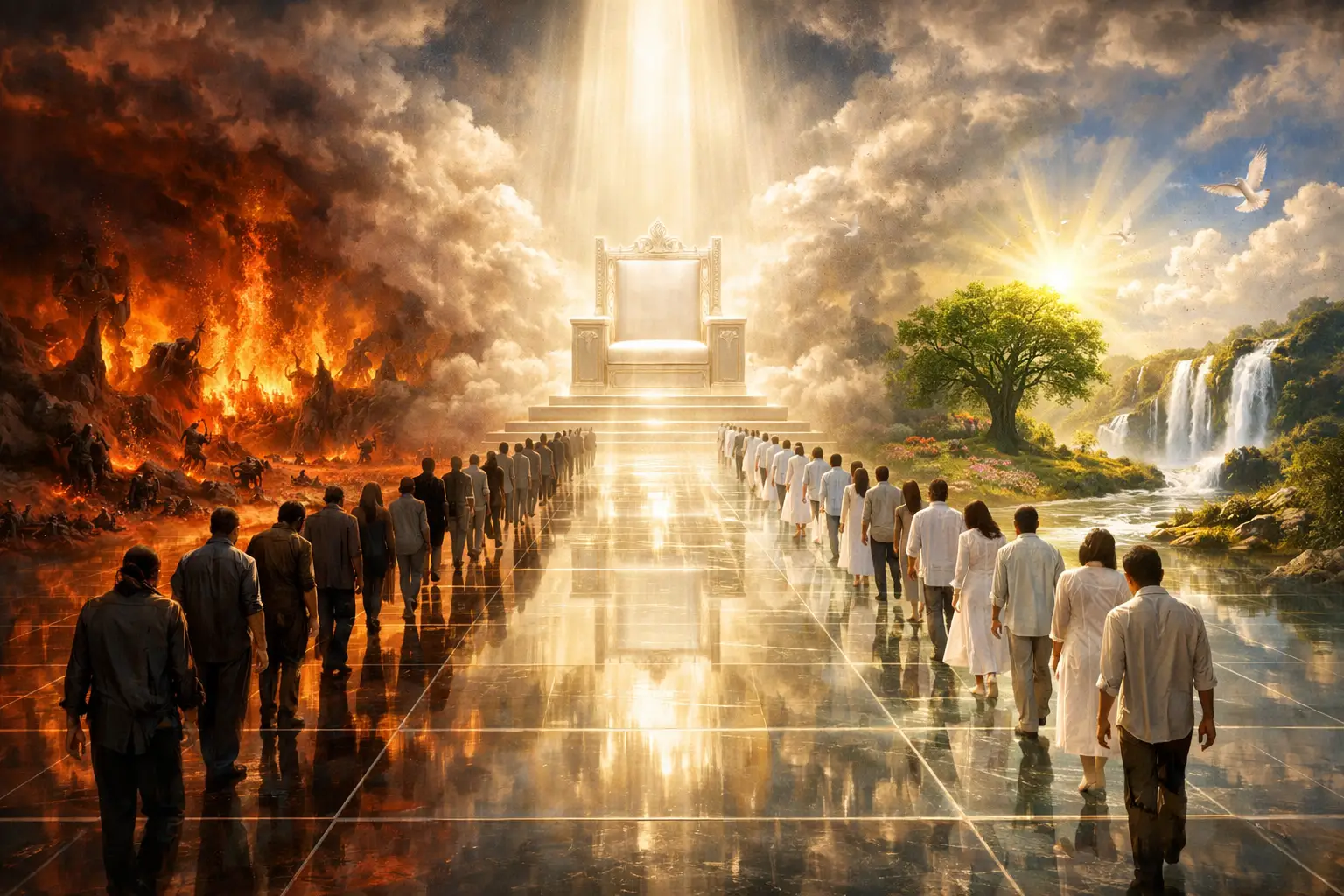
So how does this supposed tension work? The key is the duration of the punishment. Punishment, judgment, lostness are not everlasting, but temporary in character. They last exactly as long as it takes until the purpose of the punishment—setting things right—has been achieved. As human beings we partly choose our own path. That has consequences, especially for our time here on earth. But ultimately Christ will not rest until the last sheep is brought in.Postmodern
“Statements by Hoogendijk are a postmodern phenomenon. The reasoning: ‘I cannot imagine that…’ is generally decisive,” states Willem Ouweneel.
I am not quite sure what to do with this criticism. The resistance of Bible-faithful Christians against the doctrine of the endless hell, punishment, judgment is as old as the church itself.
In the first centuries, the doctrine of the ultimate salvation of all people was the belief of the great majority of Christians. Only in the fourth century, under the leadership of Augustine, did the doctrine of endless punishment arise and quickly gain ground. This was in the same period that the church became the state religion in the Roman Empire. The church became a power institution, and with that a doctrine of endless punishment (a means of power!) fits better than a doctrine of the ultimate salvation of all people. I agree with Ouweneel that “I cannot imagine that…” arguments should not be decisive. Ultimately, it is about what the Bible teaches.
“Some Christians have gone too far in the love of God,” is another statement by Frits Jongboom. I consider this a great compliment. I actually think that it is not possible to go too far in the love of God. In the Bible we even read in 1 John 4:8: “God is love.” In other words: whoever wants to describe God’s essence succinctly arrives at love. Even when He punishes or is wrathful, this proceeds from His love. His love is not sentimental or always gentle, but seeks the good for all His creatures, and His love never ceases!Eternal Fire
“According to Matthew 25, unbelievers go into the eternal fire. That does not mean that this answer is necessarily the most correct one,” Willem Ouweneel remarks.
Indeed: unbelievers go into the eternal fire, or more precisely into the lake burning with fire and sulphur. Incidentally, I do not think that Matthew 25 should be cited here, because this passage is not about belief or unbelief, but about “what have you done for the brothers” (see verse 40). My very point is that the eternal fire is not a final destination. Ouweneel does not address this. I find it hopeful that he openly dares to place question marks next to the correctness of his (for now still) traditional answer. I am curious to see where the thorough exegesis for his new book on this subject will lead.What is the value of the suffering and death of Christ if everyone is saved anyway? That is precisely the value: that everyone is saved. He is the Lamb of God, taking away the sin of the world. That is how much the sacrifice of Jesus was worth! If even one human being would not be saved, you would thereby fundamentally devalue the worth of the sacrifice of Jesus.
Wim Hoogendijk is spokesperson of the Foundation In Perspectief.
Delen:
Categories
Recent blog items
- Where Expectation Disappears
- Colossians 3:5 – Deaden, Then
- Colossians 3:4 – Appearing With Him In Glory
- Newsflash: Is a crisis looming over the Temple Mount?
- “Entirely Different in Freedom” [In vrijheid geheel anders] — Anastasia Zoë
- the rhythm of seven
- Newsflash: Netanyahu Wants U.S. Support Down to Zero
- a great affliction such as has not occurred