
 UltimateGoodNews
Do you believe Santa Claus?
06-12-2025 - Posted by Geert-JanOriginally posted on December 05, 2025 – Posted by Andre Piet
first published: 2 December 2022. Text slightly revised.
The debate about Zwarte Piet (Black Pete) has largely died down in recent years. Fine. So let’s talk about someone who is not up for debate at all: Saint Nicholas. “The good holy man” himself turns out to have played a surprising role about 1700 years ago. Did you know that this Nicholas of Myra was delegated to the Council of Nicaea in 325 AD — and that he fully supported the decisions made there?
the council of Nicaea
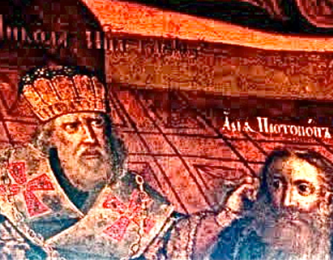
The reason for convening this council, under the leadership of Emperor Constantine, was the position of Arius from Alexandria. He rejected the idea that Jesus Christ was “God the Son,” as his opponent Athanasius claimed. The Council of Nicaea sided almost unanimously with Athanasius and condemned Arius as a heretic. Tradition recounts that the bishop of Myra (yes, that’s right, Santa Claus) struck Arius in the face on that occasion (see image). In any case, this council lies at the foundation of all Christian orthodoxy. Here the doctrine of the Trinity was officially accepted by the church, and Arius was condemned as a heretic.
departed from the sound words
The Council of Nicaea forms the foundation of formulas such as “one essence, three persons,” “God the Son,” and “Trinity.” With this, the church formally departed from “the sound words” of Scripture. Dozens of times, Scripture speaks of “God the Father,” but nowhere do we read “God the Son.” Arius was entirely right to protest against this. Jesus Christ cannot possibly be “God the Son,” because Scripture repeatedly declares: “there is one God, the Father” (1 Cor. 8:6; Eph. 4:6; John 17:3). And the Son is “the Image of the invisible God” (Col. 1:15) — God’s icon.
“whoever does not believe in the trinity cannot be saved”
The council in which Saint Nicholas participated with conviction anathematizes those who hold fast to the words of Scripture. In the “Athanasian Creed” it is declared right at the beginning:
Whoever wants to be saved must, above all, hold the catholic faith.
Whoever does not keep it whole and undefiled will undoubtedly perish eternally.
Now this is the catholic faith: that we worship one God in Trinity and the Trinity in unity…
And the document ends with the statement:
40. This is the universal faith. Unless a person believes this faithfully and firmly, he cannot be saved.
If you are a member of an orthodox church (Roman Catholic, Greek Orthodox, Calvinist, Lutheran, Baptist, Charismatic, Pentecostal, etc.), then you should know that the above words are part of your church’s confession of faith. However kindly you may be approached, if you do not confess the Trinity, then in their eyes you are not a Christian and “hell” awaits you.
disguised polytheism
The Council of Nicaea definitively confirmed the departure that the early church had already taken from the gospel that Paul had preached among the nations. Officially, they distanced themselves from the monotheism of Scripture. “One God, the Father” was the self-evident truth for the Jewish writers of the New Testament. But within a few centuries, pagan influences had distorted this into “Trinity.” It is disguised polytheism — they worship three persons.
Easter date disconnected from Passover
The Council of Nicaea also settled another issue, and both decisions are telling of the direction that was set at that time. Nicaea also determined the calculation of the Easter date: from then on, Easter was to be celebrated on the first Sunday in spring, after the full moon. With this, Easter was detached from (the Jewish) Passover. So strongly, in fact, that if Easter were ever to fall on the same day as Passover (which occasionally happens), Easter had to be pushed forward by a week. To this day, this is how the Easter date is determined. Is this not shocking?! Jesus Christ died and rose during Passover, but Nicaea issued the decree that Easter must have nothing to do with it.
officially derailed
The Council of Nicaea is one of the darkest pages in church history. Here, the Christian church officially derailed, and ever since, all of orthodoxy has continued hurtling down that same track. Just so you know.
You who are reading this surely no longer believe in Santa Claus.
But a far more important question remains: do you believe Santa Claus?
Delen:
Categories
Recent blog items
- Where Expectation Disappears
- Colossians 3:5 – Deaden, Then
- Colossians 3:4 – Appearing With Him In Glory
- Newsflash: Is a crisis looming over the Temple Mount?
- “Entirely Different in Freedom” [In vrijheid geheel anders] — Anastasia Zoë
- the rhythm of seven
- Newsflash: Netanyahu Wants U.S. Support Down to Zero
- a great affliction such as has not occurred