English Blog
Was Adam created androgynous?
16-12-2025 - Posted by Geert-JanOriginally posted on December 15, 2025 – by Andre Piet
The claim that Adam was created androgynous is meant to suggest that he originally bore both masculine and feminine characteristics: one human in whom both sexes were united, later to be separated from each other. This idea is sometimes defended on the basis of Genesis 1 and 2. However, a careful reading of Scripture does not support this.
male and female
People often refer to Genesis 1:27:
And Elohim creates the human in His image; in the image of Elohim He creates him; masculine and feminine He creates them.
–Genesis 1:27–
The thought then is that “the human” here would be one being that is both male and female. But the text itself does not say this. On the contrary, it makes a clear distinction. First, it speaks of “the human” in the singular: “He creates him.” Then follows the addition: “masculine and feminine He creates them.” The latter is plural. It is not the one human, Adam, who is called masculine and feminine, but humanity is described as consisting of two: masculine and feminine. Genesis 1 describes the end result; Genesis 2 describes how that result came to be.
not a rib but a side
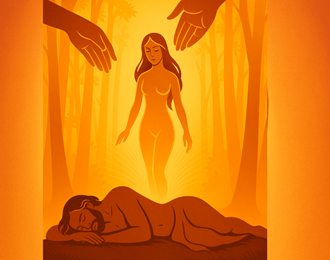
This brings us to the second argument, derived from Genesis 2. It does not say there that God took a rib from Adam, but a tsēlāʿ. That word is elsewhere used to refer to a side or side chamber, for example of the tabernacle or the temple (Ex.26:36). Based on that meaning, it is often suggested that this concerns a female side of Adam, sometimes even concretely imagined as a womb that was taken out of him.
The text itself, however, remains sober:
And YHWH Elohim is causing a stupor to fall on the human, and he is sleeping. Then He is taking one of his sides (tsēlāʿ), and is closing up the flesh in its place.
–Genesis 2:21–
What is taken away never refers to an organ, but to a side. Then this side is not replaced or restored, but “built” into a woman:
And YHWH Elohim is building the side which He took from the human into a woman.
–Genesis 2:22–
Scripture does not speak here of the removal of a female reproductive organ, but of taking building material from which the woman would be formed. It is important to note that the place left behind in Adam is “closed up with flesh.” Adam is not left mutilated or incomplete.
Adam becomes man
What stands out is that up to this point Adam is never called “man.” He is consistently referred to as: the human (ha-adam). Only after the woman is built do the words “man” and “woman” appear for the first time:
This one shall be called a “woman,” for from her man was she taken.
–Genesis 2:23–
Both terms appear simultaneously. This means that before this operation, Adam was neither man nor woman, nor both masculine and feminine. He was human. Through the taking of flesh and bone from him (Gen.2:23), the woman is built, and through the filling of the resulting space in him with flesh, he himself becomes male. In one and the same operation, woman and man come into being.
When the woman is brought to Adam, her appearance simultaneously reveals that he is man. Adam’s words in verse 23 are therefore not a dry statement, but an exclamation of recognition and delight!
the man is through the woman
This also explains Paul’s statement:
The woman is out of the man, yet the man is through the woman.
–1 Corinthians 11:12–
When Paul says that “the woman is out of the man,” he is speaking retrospectively. The woman was taken out of the one who, since her construction, is also called “man.” This is also evident from the second part: “yet the man is through the woman.” This refers to the coming into being of manhood: Adam became man through the building of the woman.
Scripture therefore does not speak of an original androgyny. Adam is not described as a bi-gendered being later split apart, but as human. Through God’s intervention, in which the woman was built, the distinction between man and woman also came into being. Adam is not referred to as male and female, but as neither male nor female. Only after the woman is built is he called “man.” In this way, the text itself shows how this distinction came about.