
 UltimateGoodNews
three times two thousand years (4) – Solomon to Cyrus
28-02-2026 - Posted by Geert-JanOriginally posted on February 27, 2026 – by Andre Piet
reading time: approximately 5 minutes
part 1 | part 2 | part 3 | part 4 | part 5 | part 6 | part 7 | part 8
from Solomon to Cyrus: five hundred years
In the previous articles it has been established that the period from Adam to Abraham comprises two thousand years and that the five hundred years from Abraham’s birth run out at the exodus from Egypt. The period from the exodus to the completion of the temple and the palace in Jerusalem under Solomon has also been described separately. Thus history up to Solomon has been placed in fixed time blocks.
In this article the subsequent phase is addressed: the period from Solomon to the first year of king Cyrus. The aim is to examine whether this period as well, according to Scripture, forms a closed whole and amounts to five hundred years, up to the end of the Babylonian devastation.
Solomon as starting point
The starting point of this period lies with Solomon, as Scripture itself marks. After the completion of the temple and the royal palace, YHWH appears to Solomon a second time and speaks words that are decisive for the further history of the kingship (-1 Kings 9:1–9-).
There not only confirmation is heard, but also warning:
Yet if you or your sons turn away from following Me (…) then I will cut off Israel from the land which I have given them
-1 Kings 9:6–7-.
In these words the path of Judah is set forth up to the ultimate devastation of city and temple. Thus this moment forms no arbitrary starting point, but the beginning of the period indicated by Scripture that runs out at the Babylonian devastation. From here Scripture also provides the data to count the time until the fall of Jerusalem.
four hundred and thirty years until the fall of Jerusalem
When the regnal years of the kings of Judah are added together, a closed period of four hundred and thirty years emerges. The calculation is made as Scripture itself counts: including the years of accession.
The table below presents this addition. It follows the data from Kings and Chronicles and shows how the reigns succeed one another until the fall of Jerusalem under Zedekiah. The short reigns of Jehoahaz and Jehoiachin are also included, because they are explicitly named as kings in Scripture.
In Chronicles the regnal years of the kings are given in whole calendar years. Portions of years are not counted. Therefore accession years are not included, since in those years two kings each reigned only part of the year.
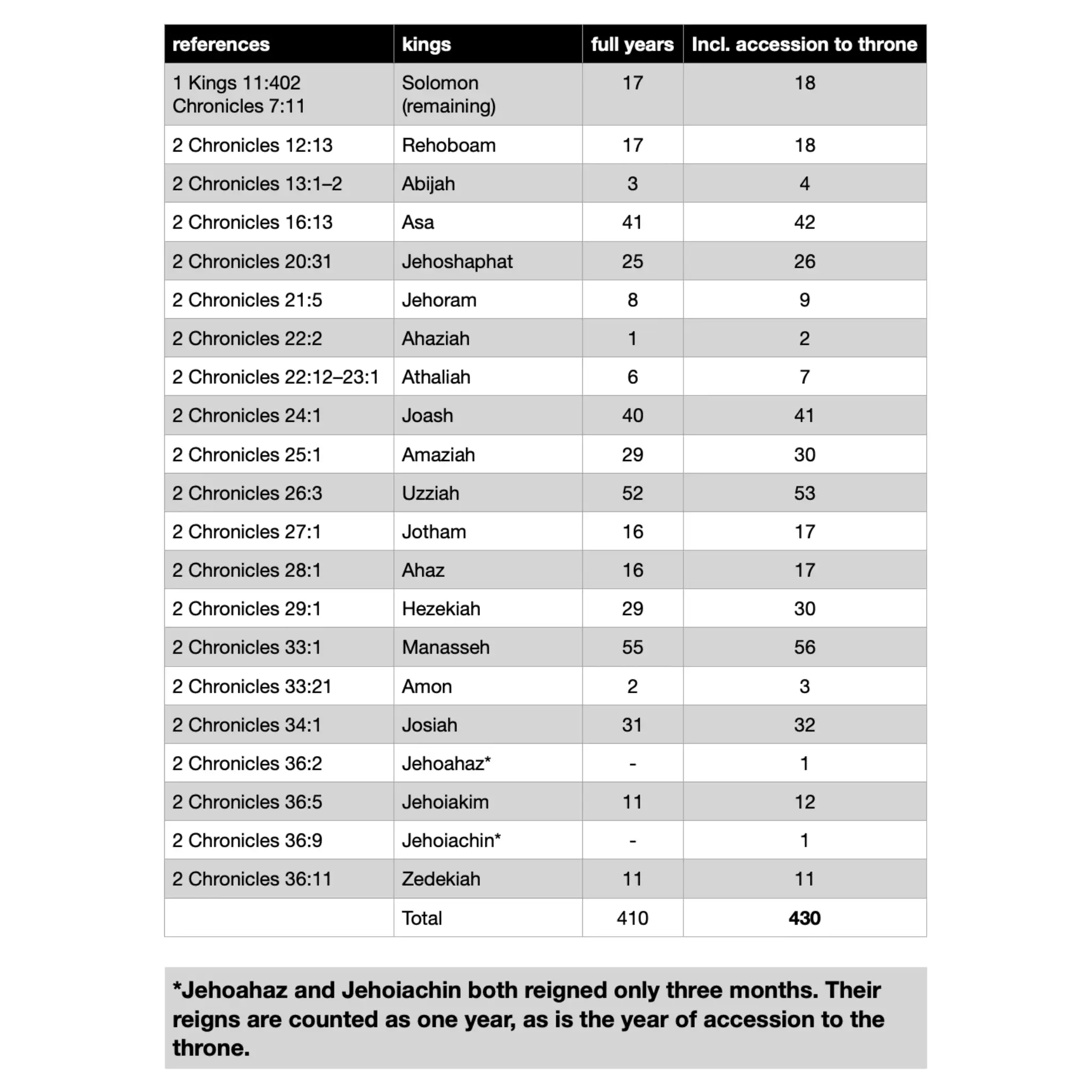
This addition does not stand on its own. It forms the first, sober counting route, which without prophetic interpretation or symbolism arrives at four hundred and thirty years from Solomon to the devastation of city and temple.
confirmation from prophecy
Besides the historical addition of the regnal years, Scripture also provides a time indication by prophetic means. In Ezekiel 4 the prophet is commanded to lie on his side for a number of days, each day standing for a year. This action concerns the iniquity of Israel and Judah and points forward to the devastation of Jerusalem.
For the house of Israel three hundred and ninety days are mentioned and for Judah forty days. Together they form a period of four hundred and thirty years. This reckoning is not derived from king lists or historical reconstructions, but is provided by the prophecy itself as the measure for the period of guilt resting upon the people.
The forty years for Judah can moreover be connected with the final prophetic phase before the devastation of Jerusalem. Jeremiah ministered as a prophet for forty years, from the end of Josiah’s reign until the fall of the city (-Jeremiah 1:1–3-). Thus this period marks the completion of the course indicated in the prophecy of Ezekiel.
It is noteworthy that this prophetic reckoning exactly corresponds with the addition of the regnal years of Judah. Two entirely different lines — one historical and one prophetic — arrive at the same number. Thus it is confirmed that the period from Solomon to the devastation of Jerusalem is not open or elastic, but is presented as a closed whole.
the seventy years of devastation
After the fall of Jerusalem follows a period which Scripture explicitly names: seventy years of devastation. These years are connected with the destruction of city and temple (-2 Chronicles 36:19–21-) and run out at the first year of king Cyrus, when the word of Jeremiah is fulfilled (-2 Chronicles 36:22-).
2 Chronicles 36 connects the seventy years with the failure to observe the sabbatical years. From the destruction of city and temple the land enjoys its sabbaths, until the seventy years are fulfilled (-2 Chron. 36:19–21-). Thus these years form the conclusion of the preceding history.
The seventy years of devastation correct nothing and repair no error in the counting. They make the period complete. The four hundred and thirty years until the fall of Jerusalem, followed by seventy years of devastation, together once again form five hundred years.
Here it becomes visible that the exile is not an interruption of the reckoning of time, but an integral part of it. Judgment and time run together here.
five hundred years completed
The period from Solomon to the first year of king Cyrus proves not to be an open or elastic whole. Along different lines Scripture shows that this phase of history is presented as a closed period. The addition of the regnal years of Judah, the prophetic indication in Ezekiel 4, and the explicitly mentioned seventy years of devastation converge into one span of five hundred years.
Thus the Babylonian devastation is no loose intermezzo in history, but the concluding part of a longer course that begins with Solomon. Judgment and time coincide here. The first year of Cyrus marks not only the end of the devastation, but also the completion of this period.
It is noteworthy that a symmetry becomes visible when these five hundred years are compared with the first five hundred years from Abraham’s birth. Then that period consisted of seventy years until the promise and four hundred and thirty years until the exodus. Here the same numbers return, but in reversed order: four hundred and thirty years until the devastation of Jerusalem and seventy years of devastation until the first year of Cyrus.
Thus Scripture also delineates this phase as an ordered whole within a larger timeline. With the restoration that begins under Cyrus, the way is opened to the next period, in which history further moves toward the coming of Israel’s Messiah.
Delen:

Categories
Recent blog items
- Where Expectation Disappears
- Colossians 3:5 – Deaden, Then
- Colossians 3:4 – Appearing With Him In Glory
- Newsflash: Is a crisis looming over the Temple Mount?
- “Entirely Different in Freedom” [In vrijheid geheel anders] — Anastasia Zoë
- the rhythm of seven
- Newsflash: Netanyahu Wants U.S. Support Down to Zero
- a great affliction such as has not occurred